
Signal Generator Calibration in the UK — Measurement Coverage & Confidence
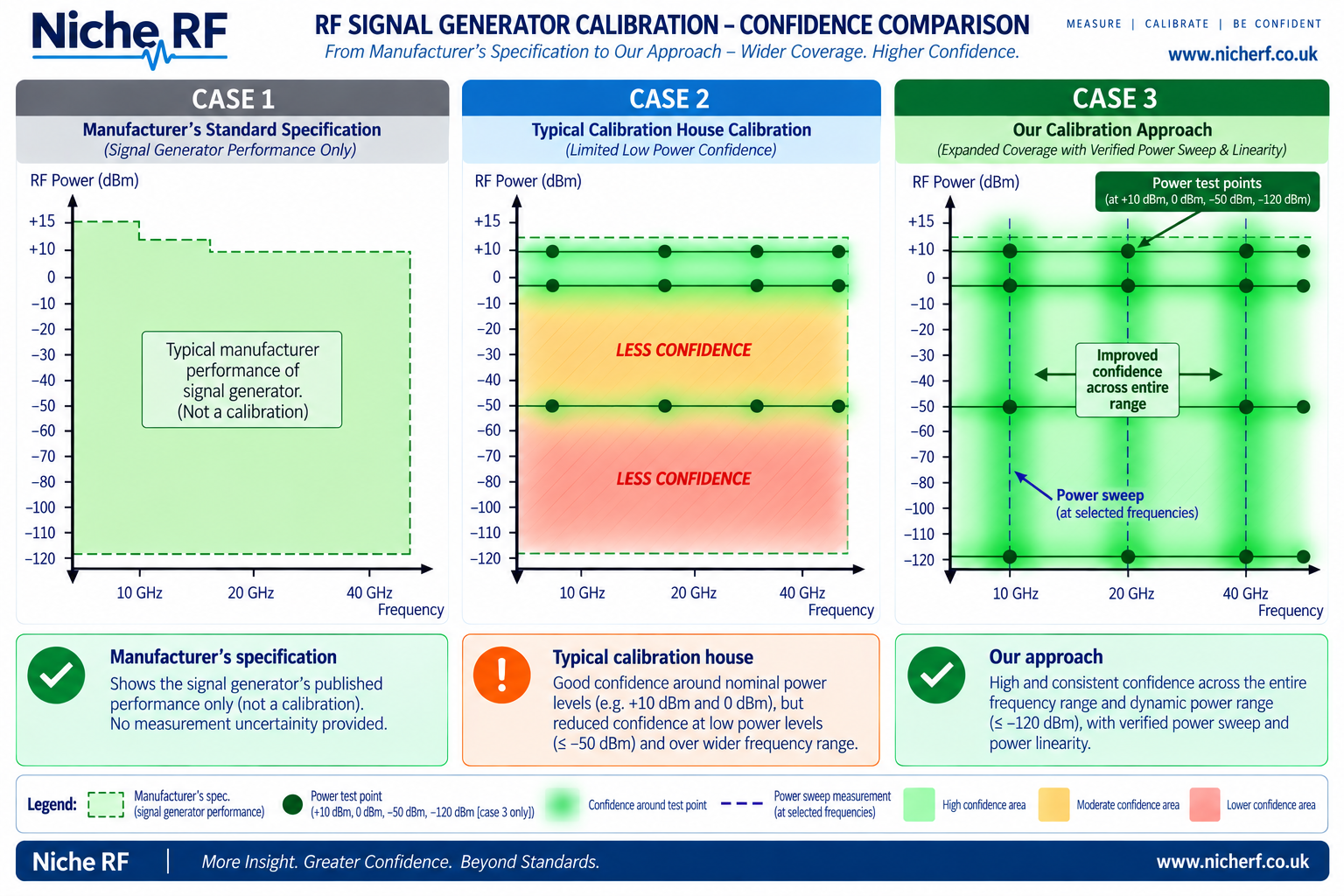
From Published Performance to Enhanced RF Characterisation
At Niche RF, we recognise that precise and dependable frequency and power generation is fundamental to RF engineering. Signal generator calibration in UK is particularly important where generators are used as reference sources for R&D, production testing, verification, fault finding and RF measurement systems. Their performance can directly influence the validity of subsequent measurements and engineering decisions. An RF source may perform correctly at individual calibration points while exhibiting unexpected behaviour elsewhere within its operating range. In some cases, these anomalies may only become apparent at particular combinations of frequency and output power. For this reason, our approach is designed to provide greater measurement coverage and a more detailed understanding of signal generator performance.Manufacturer Performance
Published Signal Generator Specification
The manufacturer’s specification defines the expected performance and operating capability of the signal generator across its specified frequency and output-power range. It also provides an essential reference for evaluating the instrument. However, the published specification describes the expected performance of the instrument type; it does not calibrate the individual instrument.
Published Specification → Expected Instrument Performance
Standard Calibration
Verification at Defined Test Points
A conventional calibration typically checks signal generator performance at a defined selection of frequency and output-power test points.
These measurements provide valuable traceable results and associated measurement uncertainty at the calibrated conditions. At the same time, they maintain an appropriate balance between technical coverage, calibration time and cost.
However, discrete test points provide less information about instrument behaviour between those measured points and throughout the complete dynamic power range.
In our experience, a signal generator can hold valid calibration status while still exhibiting localised or operating-condition-dependent anomalies. Potential causes include step attenuators, RF amplifiers, level-control or logarithmic amplifier circuits, RF switching paths, frequency-response and flatness characteristics, VCO or synthesiser circuitry, power supplies, control electronics and processor-related functions.
Furthermore, some effects may only appear at specific combinations of frequency and output level.
Defined Test Points → Confidence at Measured Conditions
Enhanced RF Calibration & Characterisation
Expanded Frequency & Dynamic-Range Verification
Our enhanced approach increases measurement coverage and provides greater visibility of signal generator performance.
Alongside discrete RF power measurements at selected frequencies and output levels, power sweeps can cover selected frequencies across the generator’s dynamic range.
This approach provides two complementary dimensions of verification:
Frequency Coverage — RF output performance is evaluated across frequency at defined power levels.
Dynamic-Range Coverage — RF output behaviour and linearity are evaluated through power sweeps at selected frequencies.
Together, these measurements provide a more comprehensive picture of generator performance. They also increase the opportunity to identify localised anomalies that may exist between conventional calibration points.
The objective is not simply to perform more measurements. Instead, we aim to obtain greater insight into RF output accuracy, consistency and linearity across the operating range. As a result, users can have greater confidence when they use the signal generator in demanding RF applications.
Expanded Measurement Coverage → Greater Performance Insight → Greater Confidence
Customer-Specific Frequencies of Interest
Enhanced Calibration Where It Matters Most
Not every RF application requires the same measurement density across the complete operating range.
For applications where a customer’s production process, R&D programme or measurement system depends critically upon a particular frequency, frequency band or power range, Niche RF can provide additional measurement coverage around those operating conditions.
Therefore, we can target additional frequency points and power-sweep characterisation at the customer’s frequencies of interest. This approach provides increased confidence in the region where measurement performance matters most.
The Niche RF Principle
Calibration confirms performance at measured points. Enhanced characterisation provides greater insight into instrument behaviour between those points.
Greater Measurement Coverage. Greater Performance Insight. Greater Confidence.
Niche RF — Measure | Calibrate | Be Confident